Rarest Answer Party scoring is built around one trade-off: submit an answer that clearly fits the prompt, but is less likely to match somebody else’s answer. The game description summarizes the rule as “the rarer your answer, the more points you get,” and the round flow shows why that is only half of the decision. A very unusual answer is useful only when the game accepts it as a valid response.
The practical priority is prompt fit first, successful submission second, rarity third. Common answers are usually safer but worth less, rare answers offer a stronger balance, and a deep-cut answer can be the best outcome when it is both recognizable and valid. The available evidence does not publish a fixed points-per-rarity formula, so use the in-game result and the current leaderboard as the authority for each round rather than treating a number from another match as guaranteed.
How Rarest Answer Party points work
Each round follows a simple chain: the game presents a category, you enter an answer before the timer ends, the answer is compared with the other submissions, and the resulting rarity affects your points. The leaderboard then applies that round’s result to the match total. This means scoring is not just a dictionary of “good” words. It is a comparison between your accepted answer and the answers submitted by the people in the current room.
The same answer can therefore perform differently in different matches. A response that feels obscure in one group may be a common choice in another group with the same interests, age range, region, or language habits. Think of rarity as a property of the prompt and the current players together, not as a permanent value attached to a word.
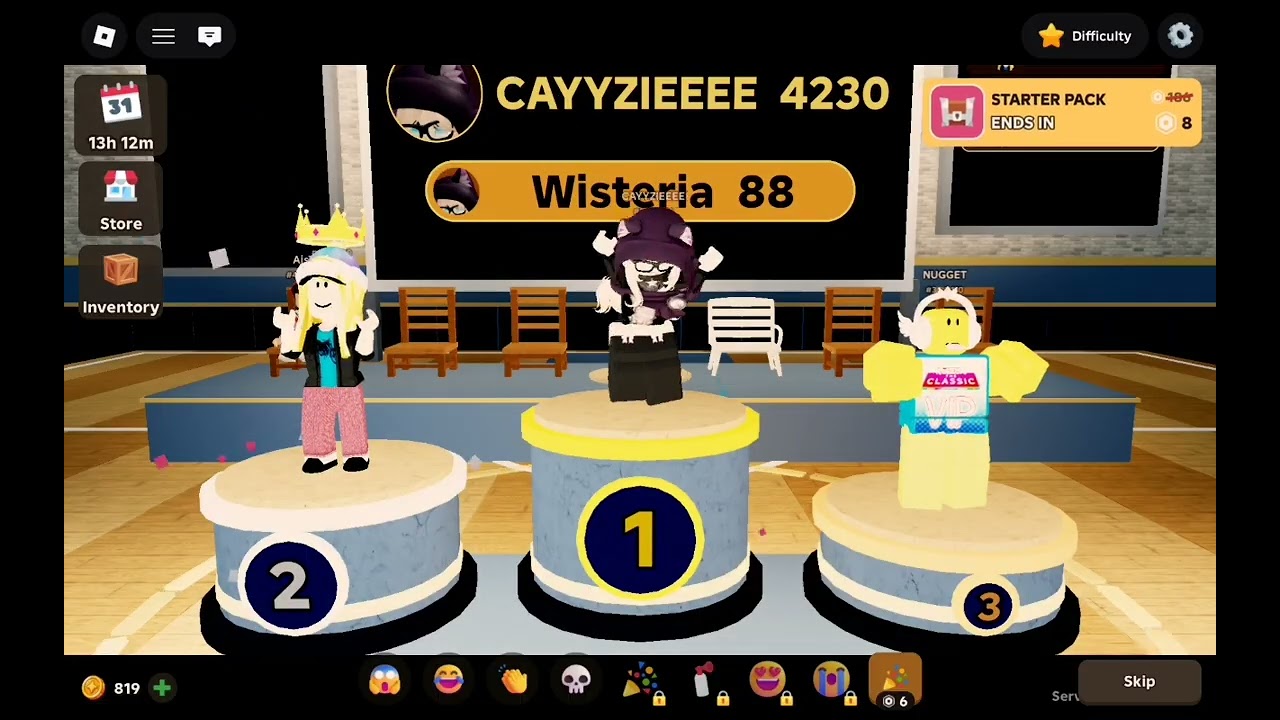
The game can show outcomes such as common, rare, or rarest. These labels describe the round result, while points measure how that result changes your score. They are related, but they are not interchangeable: finishing first on the leaderboard is a match position, not a rarity label, and a player can move from first to second or lower after a later round.
Seeing rare answer results in a scoring round
This moment supports the distinction between answer rarity and the round outcome described in this section.
Rarest Answer Party scoring levels
Use these levels as decision guides rather than as guaranteed point values. They describe the supported scoring pattern, not a published formula.
| Answer result | Scoring role | When to choose it | Main risk |
|---|---|---|---|
| Common | Usually lower points | You need a dependable answer quickly | Several players may submit the same obvious response |
| Rare | Usually medium-to-high points | You know a clear answer that is not the first idea most players will type | The answer may be misspelled or less clearly connected to the prompt |
| Deep cut | Potentially the highest reward when accepted | You have strong category knowledge and can explain the connection | A niche or ambiguous answer can fail validation or be misunderstood |
| Points | The numeric result added to the match | You are comparing the actual round outcome | The exact calculation may vary and is not documented here |
| Leaderboard | The running match ranking | You are deciding whether to protect or chase a position | One ranking snapshot does not predict the final placement |
The table’s key distinction is between rarity potential and answer reliability. A common response is not automatically bad: it can keep a player on the board when the timer is almost finished or when the category is unfamiliar. A rare response is usually the most useful target because it can create separation without requiring an extremely narrow interpretation. A deep cut is a high-risk choice, not a promise of maximum points.
The visible 250-point example from gameplay shows that a round can award a substantial score, but it does not reveal how the game calculated that number. Do not assume that every “rarest” result is worth 250 points, or that two rooms will award the same number for the same label. Treat the displayed round result as current and authoritative.
Checking the points awarded after answer evaluation
This moment provides the gameplay example of a 250-point result while the scoring formula remains unconfirmed.

What changes your round score
Prompt fit
The category limits what counts as an answer. Prompts can ask for examples from areas such as countries, vegetables, school subjects, games, characters, foods, sports, vehicles, music, entertainment, geography, science, objects, or word patterns. A response that is genuinely obscure but outside the requested category has no useful rarity advantage. It must first satisfy the prompt.
Other players’ answers
The comparison group determines how unusual your answer appears. If many players independently type the same famous example, that response is a poor route to separation even if it is perfectly valid. If the room has different interests or knowledge, the distribution can change. This is why memorizing one supposedly “rarest” answer is less reliable than learning how to make a fast category judgment.
Spelling and acceptance
A high-value idea still needs to be entered in a form the game accepts. The scoring notes specifically place spelling and successful submission ahead of rarity. When two possible answers have similar rarity, choose the one you can type confidently and that has the clearest relationship to the prompt.
The timer
The timer turns answer selection into a risk decision. With plenty of time, you can replace an obvious first thought with a less predictable but still defensible answer. With only a moment left, a known valid answer is often better than searching for a perfect deep cut and submitting nothing or something unclear.
Difficulty and room context
Rarest Answer Party offers Easy, Medium, Hard, and Random difficulty servers, and private servers can be customized for play with friends. The game information confirms those server choices but does not confirm separate scoring formulas for each difficulty. Use difficulty as a clue about the prompt and player context, not as proof that a particular rarity label has a fixed multiplier.
Choosing between safe and rare answers
Use a three-question check before submitting:
- Does it directly answer the prompt? If the connection needs a long explanation or depends on a technical interpretation, downgrade it.
- Can I enter it correctly before the timer ends? A reliable spelling and a recognizable name are part of the scoring decision.
- Is it less predictable than my first answer? If yes, it may offer a useful rarity advantage. If no, keep thinking only while there is enough time to submit safely.
This creates three practical choices. Choose the common answer when the category is unfamiliar, the timer is nearly over, or the alternative is uncertain. Choose a rare answer when you can name a clearly valid example that is not the obvious default. Choose a deep cut only when the category fit is strong and the answer is specific enough for the game to recognize.
The goal is not to make every round a gamble. A match contains multiple rounds, so a failed high-risk answer can affect the leaderboard while later prompts provide opportunities to recover. Protecting a lead calls for a different threshold from chasing last place: when ahead, favor clear validity; when behind, take a calculated rarity risk only when you can still submit a defensible answer.
How points affect the leaderboard
After an answer is evaluated, the round result changes the running total and the leaderboard shows the new positions. A strong rarity result can move a player into first, but another player’s stronger answer in the next round can change that order. The displayed position is therefore useful feedback, not a permanent assessment of your skill or the value of one answer.
Keep three things separate while reading the result screen:
- Rarity label: how your answer compared with the other submissions for that prompt.
- Points: the numeric amount awarded for that round.
- Position: where your accumulated match score currently places you.
This separation prevents two common mistakes. First, “rarest” does not mean you have already won the match. Second, a lower rarity result does not necessarily end your chances, because later rounds can change the total. The match continues through repeated prompt-and-answer stages and reaches a final round where the finishing position is shown.
There is no confirmed evidence here for a separate permanent experience balance, season score, or long-term points account. Read the match total and final placement as the relevant scoring outcomes unless the current game interface explicitly shows another system.
Scoring mistakes and recovery choices
The most expensive mistake is usually not choosing a common answer; it is choosing an answer that is too uncertain to be accepted. If you realize that a deep cut has a weak category connection, replace it before the timer ends. If the timer is already nearly finished, submit the clearest valid option you have instead of continuing to search.
If a round produces a common result, do not automatically abandon the same approach. Identify why it happened: perhaps the prompt had an obvious shared answer, or perhaps the room had similar knowledge. On the next prompt, move one level deeper while keeping the same standard of validity. If an answer is rejected or fails to score as expected, prioritize a more recognizable response in the following round and use the leaderboard only to decide how much risk you can afford.
When you are behind, avoid trying to recover with a random obscure word. A targeted rare answer in a category you understand gives you a better chance than an unsupported guess. When you are ahead, do not chase a higher label merely because another player just received it. A valid answer that preserves points is often the better match decision when the alternative could fail.
What the scoring system does not confirm
The available scoring evidence does not provide a table mapping player counts or answer ranks to exact points. It also does not establish whether Easy, Medium, Hard, and Random servers use different formulas. The 250-point observation is a real example of a visible score, but it is not a documented baseline. Likewise, the terms common, rare, and rarest describe observed outcomes; they should not be treated as guaranteed fixed multipliers.
For that reason, use the current round result, point total, and leaderboard in the game as your final reference. The stable rule is directional: an answer should be valid first and uncommon second. In a changing room, the best scoring answer is the one that balances those requirements before the timer closes.
First-time Rarest Answer Party scoring questions
Is a rarest answer always worth the most points?
No fixed amount is confirmed for every rarest result. The answer still has to fit the prompt and be accepted, and the current round result is the authority for the points awarded.
Does a common answer end my chance to win?
No. A common result may be worth less in that round, but later rounds can change the match total and leaderboard position. Use the next prompt to choose a clearly valid answer with more separation when the timer allows.
Should I use a different scoring strategy in Hard servers?
The game offers Easy, Medium, Hard, and Random servers, but the available information does not confirm different scoring formulas for them. Adjust for the prompt and room rather than assuming a difficulty-specific multiplier.